A journaling book is an odd object. It looks like something you read, but it works like something you use — a tool, a workbook, occasionally a quiet companion on a bad Tuesday. That double nature is why reviewing one takes a different set of questions than reviewing a novel or a memoir. You are not only asking "is this good?" but "does this hold up when someone actually sits down with a pen?"
The checklist below is the one I use, roughly in this order. It takes about an hour of honest use, plus a week if you want to be thorough.
First, Name the Kind of Book You're Reviewing
Journaling books get shelved together but they are not the same species. There is the prompt collection, the guided program (thirty days, twelve weeks, a year), the method book that argues for a particular way of keeping a journal, the essay collection about journaling as a practice, and the hybrid workbook that genuinely wants to be written in.
Judge the book by the promise it makes, not the one you hoped it would make. A 200-prompt collection that never claims to teach you anything should not be marked down for lacking instruction. A method book that spends forty pages on theory should not be penalised for skipping the prompts. Write the book's apparent promise in one sentence before you start judging; it sharpens everything that follows.
The Usefulness Test: Try Three Prompts for Real
Nothing reveals a journaling book faster than using it. Pick three prompts from different parts of the book — early, middle, late — and answer them as you normally would, at your normal pace, with your normal pen. Then look at what happened.
- Did you write something? Not something brilliant. Something. A prompt that produces three sentences and a shrug is doing its job. One that produces a blank stare is not.
- Did the prompt cost you anything? Good prompts ask for a small risk: a specific memory, an honest opinion, a name you have not written down before. Vague prompts ask for nothing and get it.
- Was there a next step? If the book says "reflect on your day," does it tell you how, for how long, and what to do when nothing comes? Advice without a next step is decoration.
Note the page numbers as you go. Specific examples are what separate a review people trust from a review people skim.
Interrogate the Prompts Themselves
Prompt quality is the whole ball game in most journaling books, and it is easy to assess once you know what to look for.
- Specific versus generic. Compare "What are you grateful for today?" with "Write about something small you did today that nobody noticed." The second gives your mind something to grip.
- Progression. Do the prompts build? A well-sequenced book opens with easy, factual questions and earns its way toward the harder ones.
- Variety. Lists, letters you never send, invented dialogues, timelines, one-line answers, prompts that ask you to draw. A book of forty near-identical questions will feel thin by week two.
- Padding. Count how many prompts are the same question in different clothes. It happens more often than you would think.
- Care with sensitive ground. Prompts about grief, family, money or the body need explicit permission to skip. A book that pushes without offering an exit is not brave, just careless.
- Assumptions. Does every prompt presume a partner, a job, children, a living parent? Note who the book seems to imagine as its reader.
Tone: Warm, Plain, and Brief
Read a random paragraph aloud. Does it sound like a person talking to you across a table, or like a poster in a waiting room? Journaling books fail on tone in predictable ways: forced positivity, moral instruction, baby talk, and therapy vocabulary used loosely by someone with no standing to use it. Claims about mental health deserve particular caution. A journaling book can support reflection, but it is not treatment, and any book implying otherwise deserves a sceptical line in your review. If it makes claims about anxiety, trauma or depression, say plainly that readers should speak to a qualified professional rather than lean on a workbook.
What you want instead is permission. Good journaling writing says: five minutes counts. Mess counts. You can skip this page. Look for sentences that lower the bar rather than raise it.
Structure, Layout, and Whether the Book Is Usable
Here the physical object matters as much as the text.
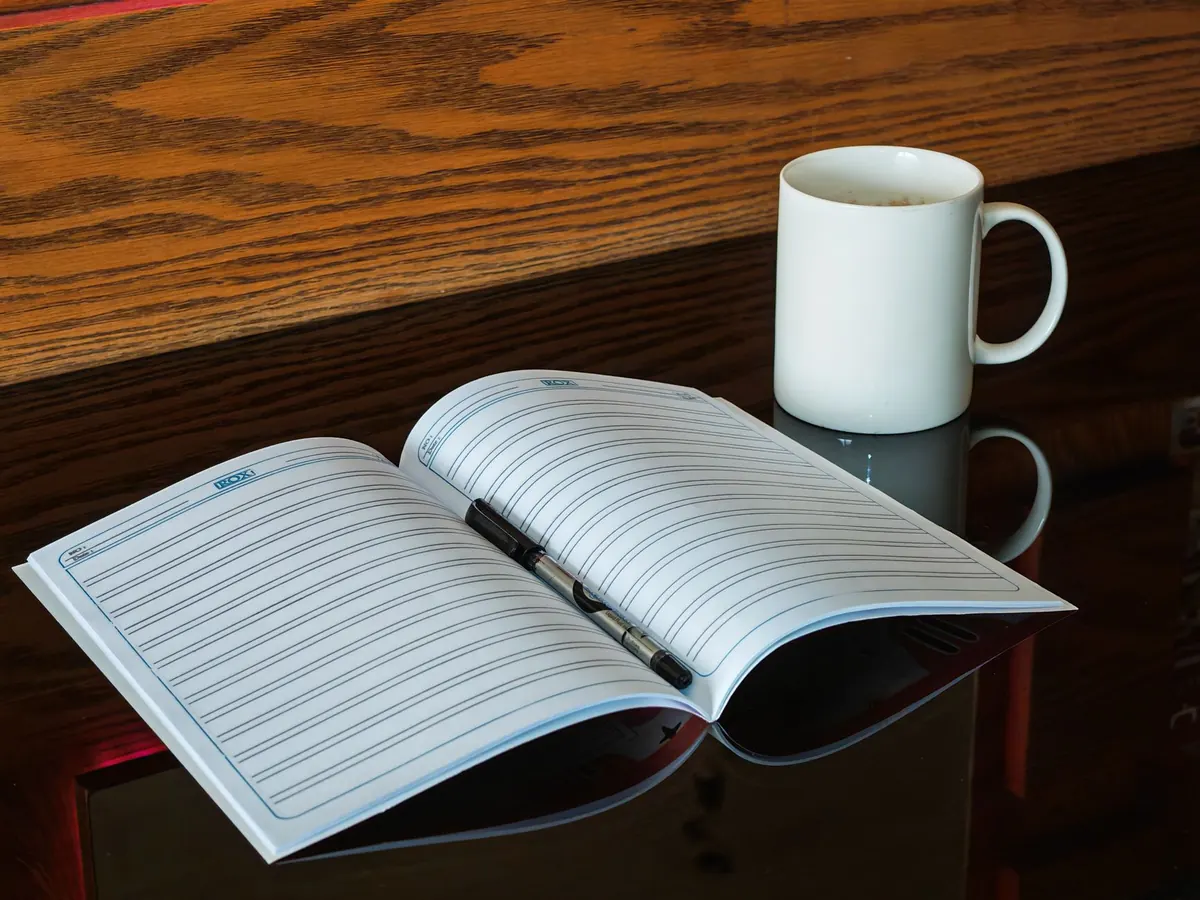
- Room to write. Are the lines far enough apart for adult handwriting? Are the margins generous, or does the design squeeze you into a corner?
- Paper and binding. Does ink bleed through? Does the book lie flat, or fight you on every page? If you write with a fountain pen or marker, this alone can decide the matter.
- Finding your way around. Is there a contents page? Can you open at page 80 and know what you are meant to do? A guided program should state whether it expects daily, weekly or occasional use.
- Read versus write. Some readers never write in books. If the design forces them to, that belongs in the review.
The First Twenty Pages Test for Beginners
If a friend has never kept a journal, hand them the first twenty pages. Do they know what to do next? Beginner friendliness is not the same as simplicity — it is the absence of obstacles.
A beginner-friendly book defines journaling without mystique, addresses the two great fears (I don't know what to write, and I missed four days), and offers a five-minute version of its own method. It shows an entry or two so you can see what "doing it wrong" looks like — usually, it looks fine. It also explains the difference between a few common approaches, such as freewriting, gratitude logs and dated diary entries, without insisting that one is superior. Strong books return to the missed-days question more than once, because that is where most habits quietly die.
A Ten-Point Checklist to Fill In
Before writing a word of the review, run the book through this and mark each line yes, no, or partly.
- The book keeps the promise its cover and introduction make.
- Three sample prompts produced actual writing.
- Prompts are specific, varied, and not padded with repeats.
- Sensitive prompts include permission to skip.
- The tone is plain and encouraging, not preachy.
- Claims about mental health are modest and appropriate.
- The layout gives enough room to write, on paper that behaves.
- You can use the book without reading it cover to cover.
- A complete beginner would know what to do after twenty pages.
- You can name one page you would recommend to a friend, and one you would warn them about.
Turning the Checklist Into a Review Worth Reading
Now write. Four short paragraphs will do more than ten long ones: who the book suits, what it does unusually well, where it stumbles, and who should skip it. Use page numbers. Say whether you finished it, and be honest about your own habits — someone who journals twice a week reviews a daily-prompt book differently from someone who journals daily, and both views are useful when stated openly.
Mention the format if it matters: a workbook that only works in print, or one whose layout collapses on an e-reader, is worth flagging. Separate "not for me" from "bad," and say which one you mean. And keep one sentence for the reader standing in a bookshop, thumbing the first chapter, wondering whether to spend the money. That sentence is the whole job.
Photo: dlxmedia.hu / Pexels