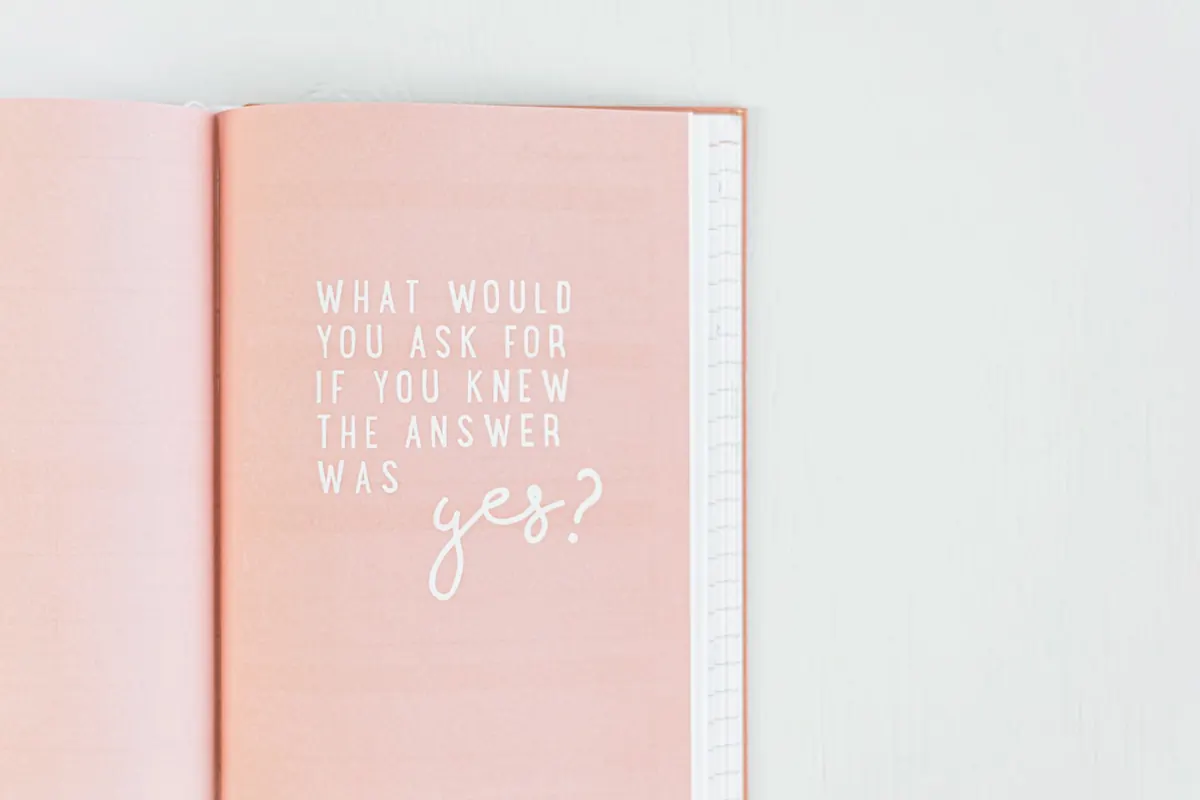
Some days the page is not a blank canvas. It's a wall. You sit down with the honest intention to write something true, and instead you rearrange your desk, reread an entry from March, and start nine sentences you never finish.
Being stuck rarely means there's nothing going on inside. More often it means too much is going on at once, with no obvious place to begin. A prompt is just a small door into the room. You don't have to find the right one — only the one that matches the mood you're actually in, not the mood you think you should be in.
What follows are thirty prompts, grouped by the kind of stuck you're carrying. Pick one. Set a timer for six minutes. Keep the pen moving even when the sentence turns dull, because the dull stretch is usually where the useful part is hiding.
When everything feels like too much
Overwhelm is not the absence of thoughts; it's the presence of too many at the same volume. These prompts are about turning the noise down far enough to hear one thing clearly.
- List the three things taking up the most space in your head right now. Next to each, write whether it is actually yours to carry this week.
- If you could cancel one commitment with no explanation and no guilt, which would it be — and what would you do with the hour you got back?
- Describe the last moment today when your shoulders dropped. What were you doing, and who was nearby?
- What is the smallest thing that would make the next twenty-four hours easier? Not the best thing. The smallest.
- Write about your day as if you were a calm person watching it through a window. What do you notice that the version of you inside the room cannot see?
When you feel flat, bored, or disconnected
Flatness is harder to write about than sadness, because there's so little to grab hold of. Don't try to manufacture feeling. Describe the absence instead — it's just as informative, and often more honest.
- Name five things you used to care about that have gone quiet. Circle the one you'd most like to hear from again.
- What did you do in the last two weeks purely because you wanted to, with nobody expecting it of you?
- Describe a place you know well, down to the smell of it. Then write about why you stopped going.
- Finish this sentence three different ways: "I would be more interested in my days if…"
When you're avoiding something you know you need to do
Avoidance is rarely about laziness. It's usually about a specific fear wearing a very good disguise. The trick is to make the fear concrete enough to write down, because a vague dread is far heavier than a named one.
- Name the thing you've been circling for more than a week. Now write the version of it that fits into fifteen minutes.
- What exactly do you think will happen if you start? Be specific — a real consequence, not a feeling.
- Who are you imagining is watching you do this? Describe them. Are they in the room?
- What is the first physical action — not the plan, the action? Opening the file, finding the form, putting on your shoes.
- Write yourself a permission slip to do this badly. Date it, sign it, and keep it on the page.
When you're standing at a fork in the road
Big decisions resist journaling because we want the page to tell us what to do. It won't. What it can do is show you which option you keep returning to when you stop performing certainty.
- Write both options as if a friend were choosing between them. What would you say to them, and does it sound like advice you'd take?
- Which choice would you make if nobody would ever know about it?
- Write what you hope will happen and what you're afraid will happen, side by side, without editing either.
- Describe an ordinary Tuesday six months from now under each option. Which version can you picture in more detail?
The page doesn't solve the decision. It shows you which one you've already started living inside.
When the inner critic won't quiet down
Self-criticism is loud partly because it's fast. Writing slows it to the speed of your handwriting, which is often enough to reveal how repetitive it is — and how little evidence it's actually working with.
- Copy down the harshest sentence your critic has said to you this month, word for word. Then read it back slowly.
- Whose voice does it sound like? Write the name, if there is one, and one thing that voice got wrong about you.
- What would you say to a friend who told you exactly what you just told yourself?
- List three things you did this week that your critic refused to count. Count them now, in writing.
- What standard are you holding yourself to that you would never hand to another person?
When you don't know what you feel
Sometimes there is no name for it yet. Skip the analysis and start with the physical, the concrete, the scene. Feeling tends to arrive sideways while you're describing something else.
- Describe today's mood as a room. What's in it, where is the light coming from, who is standing in the corner?
- Where are you carrying tension right now — jaw, shoulders, stomach, hands? Start there and see which words arrive.
- Write the sentence you would say out loud if the room were empty.
- What have you been calling tiredness that might actually be anger, grief, or boredom?
- Finish this line and keep going for three minutes: "I keep thinking about…"
- What's the last thing that made you laugh properly? Write the scene in detail, including who was there.
- If this week had a title, what would it be — and what would the next chapter be called?
How to use these prompts without turning them into homework
A prompt list can become another thing to fail at. It shouldn't. The goal is six minutes of honest writing, not a finished piece, and certainly not a tidy answer.
- Set a timer, not a target. Six minutes is enough to get past the polite first paragraph and into something with a pulse.
- Write badly on purpose. Cross things out, contradict yourself, leave sentences unfinished. Nobody is marking this.
- Skip anything that doesn't fit. If a prompt feels like a chore, it's the wrong prompt for today. There are twenty-nine others.
- Date every page and don't reread it for a week. Distance makes patterns visible; immediate rereading only invites edits.
If a prompt opens something heavier
Occasionally a question about anger or exhaustion leads somewhere bigger than a journal entry can hold. That's worth taking seriously. Writing is a good first step and a poor substitute for support — if something keeps surfacing, talk it through with someone qualified to help, whether that's a doctor, a therapist or a counsellor.
Keep the list somewhere you'll find it on a bad evening: the back of a notebook, a note on your phone, a card tucked inside the cover. The next time you sit down and the wall is there again, you won't have to invent a way through it. You'll just open the page, pick a number, and start.
Photo: Studio Layana / Pexels